
E-learning tip: how to invite properly!
Increase the number of participants in your online courses.

Increase the number of participants in your online courses.
Online training and e-learning courses have arrived in all companies since COVID at the latest, and they've come to stay. Even though in some situations nothing beats classroom training: the cost/benefit advantage of online training is simply exorbitant. The only problem: the participation rate often leaves much to be desired. And understandably so.
Let's face it: we (IS-FOX) are convinced that with our e-learning courses on cyber security, data protection, occupational health and safety or compliance, we offer just about the coolest thing you can get in this solar system :-) . Nevertheless, we know one thing for sure: no employee in any company is eagerly waiting to finally complete our online courses.
On the contrary! Invitations to e-learning courses usually rank between "really, now?" and "oh man, even more work!". That's why participation rates for voluntary online courses average only 1 to 5 percent; not for IS-FOX courses, for all courses. And, by the way, with newsletters, too. If you remain properly penetrative and send first and second reminders to the "non responsive" course participants, you can also increase this figure to 25%. Still not what you might call company-wide adoption.
Training courses on occupational safety, data protection and compliance often have legal requirements that make participation mandatory. However, mandatory does not mean that everyone will actually participate, because employees learn quickly: if it says "mandatory" but nothing happens, if you simply ignore it, then many potential participants will decide to go with option B first. And we can't even blame them, because mandatory training courses, especially on data protection, occupational health and safety and compliance, are often so dull and uninspiring, full of "lawyer-speak" and unnecessary details, that people don't even want to attend them. Of course, this is not the case with our IS-FOX training courses, but not everyone knows this of course. ;-)
However: with a mandatory course, you usually get a reasonable participation rate, but you have to go through the works council (at least in Germany), you have to make these online courses available abroad in the local language, and of course you should also offer an accessible version for employees with disabilities. And you' re usually not the only department that would like to have its training mandatory, which doesn't make things any easier.
For many people responsible, especially in the area of cyber security, the only option is often a voluntary offering. And that brings us back to our maximum average of 25%.
Our tip: combine the start of the cyber security e-learning with a phishing simulation. Send all potential participants a phishing email with a neat click carrot in front, for example Apple products for free for a bit of testing effort. All users who click on it and register get a resolution telling them, with a twinkle in the eye, that this wasn't their best idea today, but it could have happened to anyone ... and that we have a very cool security training course where you can learn to recognize and defend against such attacks. A very charming example is our IS-FOX Cyber Attacker.
Since hopefully not everyone will fall for the phishing test, you (or even better: your management) will send a "real" invitation to all employees after 24-48 hours with the resolution of the phishing action and the call to attend the e-learning. Accompany this with an interview on the intranet, and you have turned the launch of an e-learning course into a small security awareness campaign. And you can achieve participation rates of 50-70% in the e-learning, because a well-done, positively energized phishing test creates viral marketing and is a topic of conversation at lunch and in team meetings. A poorly made phishing test does that too, but the effects are exactly the opposite of what you want.
If you would like more advice on this or would like to know how Lanxess won the Digital Leader Award in Cyber Security 2020 with these and other elements, hit the contact button above or give us a call.
Let's talk about your needs in a web meeting. We'll show you how to motivate your employees.
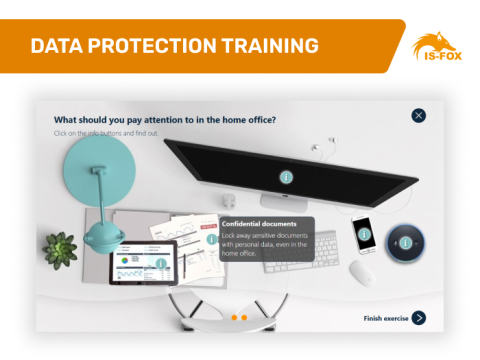
Up-to-date and modern online data protection training courses make your employees fit for GDPR. Find out more and book training now!
Modern and entertaining IT security trainings protect your company from attacks and their consequences.
E-learning course for all employees or specific target groups.

How to repackage familiar GDPR content into exciting online courses.

In this article, we explain the technical terms Scorm, LMS and e-learning course.

Technical settings and tips for LMS administrators